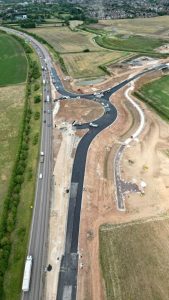
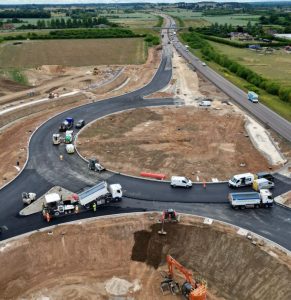
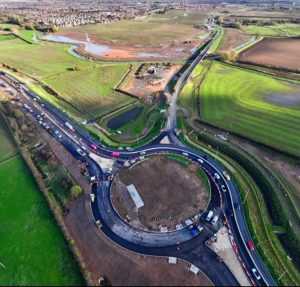
Holcim UK was appointed as surfacing contractor on the A46 Farndon Roundabout scheme, delivered on behalf of National Highways with Breheny acting as principal contractor. The £1.6m project formed part of a wider infrastructure improvement programme, including the construction of a new link road connecting the roundabout to the A1 Southern Relief Road and tie-ins to the A17. The scheme was designed to ease traffic congestion, improve network resilience and support future growth within the region.
OCL Regenerations role encompassed the supply and installation of Cement Bound Granular Material (CBGM), while Holcim installed the base, binder and surface course layers across the new build carriageway and associated tie-ins to the existing A46.

Technical development and specification
A key technical element of the scheme involved the use of CBGM within the pavement construction. While the material had been included within the original design, Holcim/OCL proposed a revised approach to optimise constructability and reduce programme risk. The initial specification would have required a thicker, stronger mix laid in two layers, which presented delivery challenges within the available working windows.
Holcim worked collaboratively with the project team to suggest thinning the CBGM layer while maintaining required structural performance. This solution improved practicality on site, reduced complexity and supported more efficient phasing of the works. The proposal demonstrated Holcim and OCL’s ability to positively influence specification to enhance buildability without compromising the compliance or long-term asset performance.
In addition bulk planing of the existing A46 carriageway was undertaken to align levels and accelerate the programme, ensuring smooth tie-ins between new and existing infrastructure.
Materials and delivery strategy
The scheme was delivered across four phases, including crossovers, southbound A46 works, northbound A46 works and the central reservation. Works commenced in March 2025 with subsequent phases delivered in June 2025 and November 2025 and final central reservation works completed in March 2026.
OCL Regeneration supplied and installed approximately 6,500 tonnes of CBGM, 8,000 tonnes of dense base, 2,000 tonnes of binder course and 1,100 tonnes of 10mm SMA surface course. In addition 260 tonnes of a high-friction surface course was installed on specified approaches to meet safety performance requirements.
To support sustainability an OCL Regeneration on-site plant was deployed to manufacture CBGM directly within the scheme boundary, improving programme control and reducing reliance on off-site supply. The on-site recycling plant minimised transport emissions having to travel for alternative asphalt plants in the vicinity. Additional asphalt materials were supplied from Holcim’s Sheffield and Bardon plants to ensure continuity of supply across the phased programme.
Delivery was managed by a dedicated gang and supervisor, maintaining consistent quality control and clear communication throughout the works.
Carbon reduction and environmental performance
The introduction of Foamix delivered substantial carbon savings across the scheme. The substitution of warm mix asphalt in the base course achieved an overall carbon reduction of approximately 60% reducing total embodied carbon from 1,700,000 kgCO₂e to 672,174 kgCO₂e.
These savings were achieved through:
• Ambient temperature production
• High recycled material content
• Reduced transport distances
• On-site manufacturing efficiencies
In addition the use of high recycled content materials prevented the extraction of approximately 32,000 tonnes of virgin aggregate, directly reducing demand on primary quarry resources and supporting LCC’s sustainability and net-zero ambitions
Collaboration and quality assurance
Holcim and OCL Regeneration worked closely with National Highways and Breheny to ensure alignment with programme and traffic management requirements. An Inspection and Test Plan (ITP) was supplied and internal quality control measures were implemented throughout the works to ensure full compliance with specification.
Strong collaboration across the project team enabled efficient phasing and effective management of live traffic interfaces. Despite periods of wet weather that caused programme delays, proactive planning and coordinated sequencing ensured deadlines were met.
Sustainability and resource
The scheme incorporated circular economy principles through the reuse of planings within the county, including material utilised for CBGM production. This approach reduced waste, lowered demand for virgin aggregate and supported National Highways’ sustainability objectives.
The use of an on-site CBGM plant further enhanced efficiency by reducing material haulage distances and associated vehicle movements, improving both environmental performance and programme resilience.
Delivery performance and collaborative success
The A46 Farndon Roundabout scheme was delivered safely and accident free across all four phases. Holcim successfully self-delivered complex new build surfacing works within a live strategic road environment, maintaining quality, productivity and compliance throughout.
The completed link road and carriageway improvements have enhanced traffic flow, reduced congestion and strengthened connectivity between the A46, A1 and A17 corridors. The project demonstrates Holcim UK’s capability to deliver large-scale, multi-phase infrastructure schemes while influencing specification through Early Contractor Involvement (ECI), optimising buildability and supporting sustainable construction outcomes.